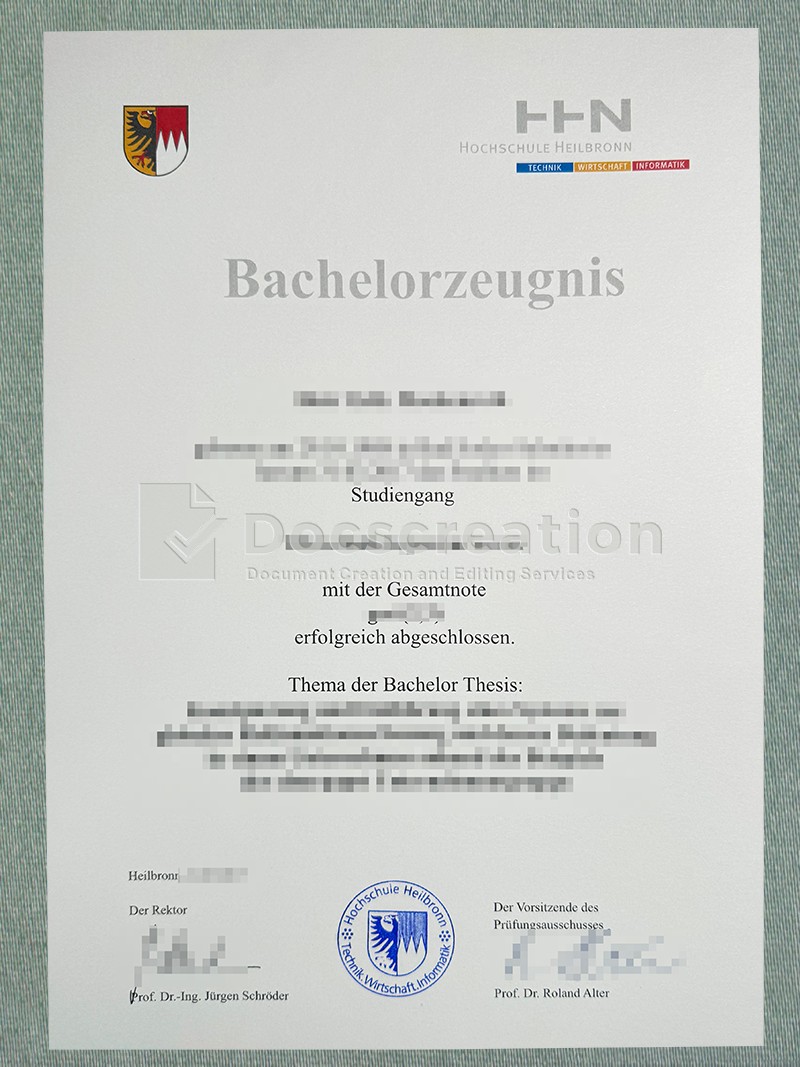
Heilbronn University of Applied Sciences (HNN) was founded in 1972 and evolved from the State School of Engineering established in 1961; it is a renowned public university of applied sciences in Germany. Located in Baden-Württemberg, one of Germany’s wealthiest federal states, it is one of the largest universities of applied sciences in the state, with four campuses and an enrolment of 8,200 students. These campuses are Heilbronn-Sonheim, Heilbronn-Peltonskamp, Kunzelsau and Schwäbisch Hall.
With established faculties
The university comprises the First Faculty of Engineering, the Second Faculty of Engineering and Technology, the Faculty of Computer Science, the First Faculty of Economics, the Second Faculty of Economics, and the Faculty of Engineering and Economics. It offers undergraduate and postgraduate programmes, with a broad range of disciplines covering engineering sciences, economics and computer and information sciences. Among these, automotive systems, electrical systems, mechatronics and robotics, and mechanical engineering are the university’s areas of particular strength.
What is the university like?
The university is a welcoming, friendly and dynamic institution committed to innovation and interdisciplinary knowledge transfer. It works closely with numerous partners in business, industry and the local community to create a sustainable, fair and ethical learning environment for students. The diverse range of study programmes in business studies, engineering and information technology provides a solid theoretical foundation, whilst integrating professional elements such as industrial placements or project work to enhance students’ cross-functional and interdisciplinary key competencies. Hailbronn University of Applied Sciences collaborates with approximately 220 universities worldwide.To have digital artwork produced in Germany, simply provide a digital sample Hochschule Heilbronn Document Zeugnis; we guarantee that both the quality and service will meet your requirements.
The German Education System
Higher education institutions in Germany include comprehensive universities, universities of applied sciences (Fachhochschulen) and colleges of music and the arts. Comprehensive universities offer a wide range of disciplines and specialisations, with a primary focus on teaching and research. These institutions are authorised to award bachelor’s, master’s and doctoral degrees. Universities of applied sciences, also known as Fachhochschulen, focus on training students for practical careers; students can obtain a bachelor’s degree after 3 to 3.5 years of specialised study. Some universities of applied sciences also offer postgraduate programmes lasting between 1.5 and 2 years, upon completion of which students may be awarded a Master’s degree.
Generally speaking, universities of applied sciences do not have the authority to award doctoral degrees. The academic year at German universities consists of two semesters: from October to February of the following year, and from April to July. The primary language of instruction at German universities is German, although some institutions are gradually introducing international programmes taught in English. International students are usually required to pass a German language proficiency test for university admission. Renowned German universities include Charles University, the University of Munich, the University of Heidelberg, the Technical University of Munich, Humboldt University of Berlin, the Free University of Berlin, the University of Bonn, the University of Göttingen and the University of Hamburg. If you urgently need university documents produced, you can turn to DocsCreation to provide a certificate that serves as a temporary substitute for your qualifications.