The University of Münster is one of Germany’s largest and most renowned public universities. It was founded in 1780. In 1902, it received its current name—Wilhelm University of Münster-Westphalia—from Emperor Wilhelm II of Germany. Students come to Münster to study for many reasons, such as the wide range of majors available, including some with a touch of exotic flair or in smaller fields, such as mineralogy; its larger faculties—such as the Faculty of Economics, the Faculty of Medicine, and the Faculty of Law—are highly regarded (ranking among the top institutions in the 2001 *Star* magazine university rankings), which often leads to overcrowded classrooms. In addition, many students appreciate Münster’s pleasant environment: most streets are bike-friendly, the network of bike paths is well-developed, and the city is picturesque and peaceful, offering an atmosphere ideal for studying.
Student Life
- The University of Münster offers a very rich student life. The sports club Hochschulsport provides over 100 sports courses, sports trips, continuing education programs, and international competitions.
- The information technology organization Zentrum für Informationsverarbeitung (Ziv) serves as a central hub for information processing and communication technology, providing IT facilities for both standard and specialized software.
- The Language Center (Sprachenzentrum) offers traditional language courses, tandem courses (mutual language learning between native speakers of different languages), and language certificates (such as UNIcert).
- Cultural offerings include a variety of museums, music (choirs, vocal ensembles, and orchestras), theaters, and movie theaters. In addition, there are various student organizations (AIESEC, AEGEE, move, MTP, etc.).
- The city of Münster itself boasts a very lively nightlife, with over 1,000 bars and clubs. At the same time, Münster also features a rich cultural scene.
Remedial Measures for Lost Degree Documents
If you lose your degree documents, you can apply to the Technical University of Darmstadt for a Zweitschrift (duplicate). This duplicate is officially reissued by the university and has the same legal validity as the original document.
To apply, you must fill out a designated form and provide proof of identity. The fee is 55 euros per document, which covers degree certificates, transcripts, or the Diploma Supplement. Processing takes approximately 2 to 4 weeks, and you can choose to pick up the documents in person or have them mailed (limited to addresses within Germany).
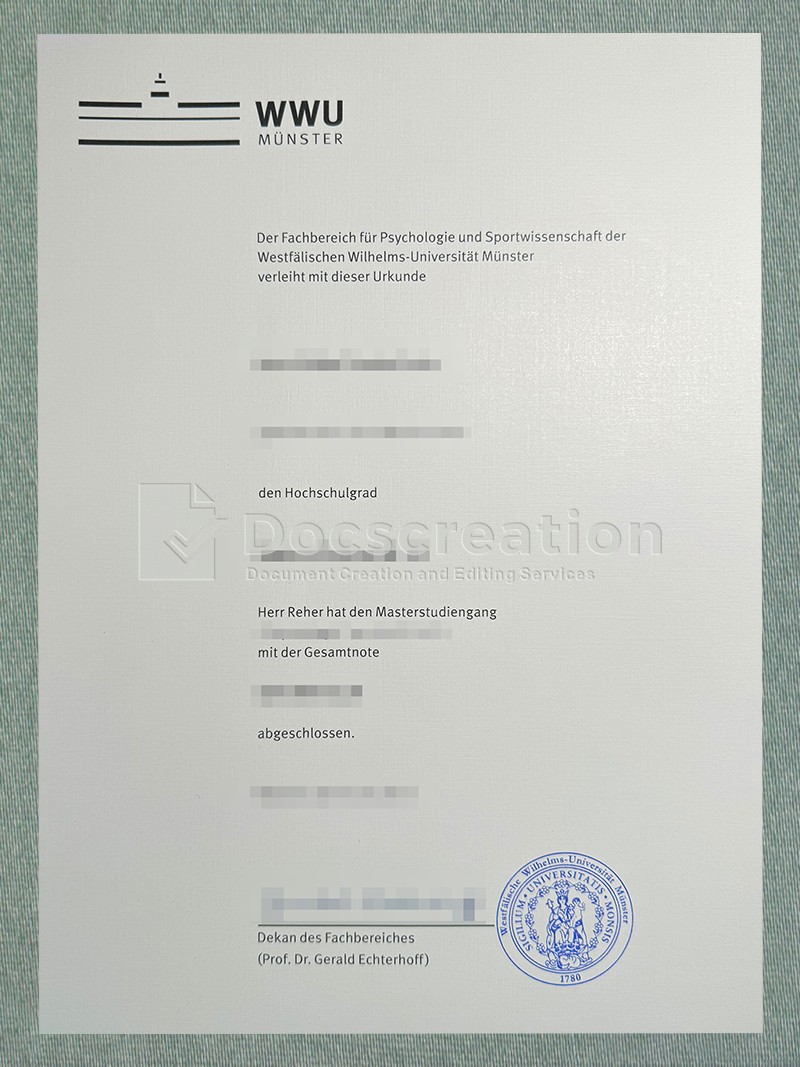
If, due to special circumstances, you are unable to reissue a document, you can create a replacement University of Münster Dokument Urkunde through Docs to ensure its quality and timely delivery.
Notable Alumni
- Gerhard Domagk (1895–1964), pathologist and bacteriologist, Nobel Prize in Physiology or Medicine (1939)
- Gustav Walter Heinemann (1899–1976), President of the Federal Republic of Germany
- Johannes Georg Bednorz (1950–), Nobel Prize in Physics (1987)
- Mikhail Sergeyevich Gorbachev (1931–), Honorary Doctor of Laws (2005), Nobel Peace Prize (1990)
- Josef Ratzinger (1927–), Benedict XVI, Pope of the Roman Catholic Church, Professor of Theology, 1963–66